

In the world of high-end art book production, the leap from a digital screen to a physical page is the most treacherous part of the journey. You’ve spent months perfecting every brushstroke and color grade, but without a hard proof, you are essentially flying blind.
At ArtBook Printing, we treat the proofing stage as the “sacred contract” between your creative vision and our mechanical precision. This post explores why physical hard proofs are non-negotiable for serious art book projects and how they safeguard your investment.
1. The Screen vs. Paper Paradox
The fundamental reason for hard proofs lies in the physics of light.
· Transmitted Light (Screens): Your monitor uses RGB light projected directly into your eyes. It is vibrant, backlit, and capable of displaying “impossible” neon colors.
· Reflected Light (Paper): A printed book uses CMYK pigments. You only see the color when ambient light reflects off the ink and the paper fibers.
A hard proof is a physical, color-calibrated sample that translates those digital light-waves into physical ink. It is the only way to see if your deep violets will turn into “muddy” browns or if your shadow details will be lost in a sea of black ink.
2. Catching the “Invisible” Errors
Digital PDF proofs are excellent for checking typos or layout alignment, but they hide technical “pre-flight” issues that only appear in the real world. A hard proof reveals:
· Moiré Patterns: Strange “ripples” in images that occur when digital sensors and printing screens clash.
· Banding: Subtle “steps” in color gradients (like a clear blue sky) that look smooth on screen but can appear striped on paper.
· Rich Black Mismatches: Ensuring that your deep blacks have a consistent “warmth” or “coolness” throughout the entire book.
3. The Different Types of Hard Proofs
At ArtBook Printing, we offer various levels of physical verification to match your project’s complexity.
| Proof Type | Best For… | What it Shows |
| Digital Contract Proof | Color-critical art books | 98% color accuracy using calibrated Epson inkjet technology. |
| Wet Proof (Press Proof) | Ultra-high-end museum books | Printed on the actual offset press and the exact paper stock of your final run. |
| F&Gs (Folded & Gathered) | Final layout check | The actual pages after offset printing, but before they are bound into the cover. |
| The Paper Dummy | Tactile feel | An unprinted version of your book using the exact paper and binding weight so you can feel the “heft.” |
4. The Lighting Environment: A Crucial Variable
One of the most overlooked benefits of a hard proof is the ability to view your art under different lighting conditions.
· Gallery Lighting: Does the art look right under warm spotlights?
· Natural Light: How does the color shift when viewed by a window?
· D50 Standard: Professional printers view proofs under “D50” (5000K) lighting to simulate neutral daylight. A hard proof allows you to move the “art” into your world to see how it truly lives.
5. Safeguarding Your Financial Investment
An art book run is a significant financial commitment. Approving an $80,000 print run based on a PDF file is a risk that most professional artists cannot afford.
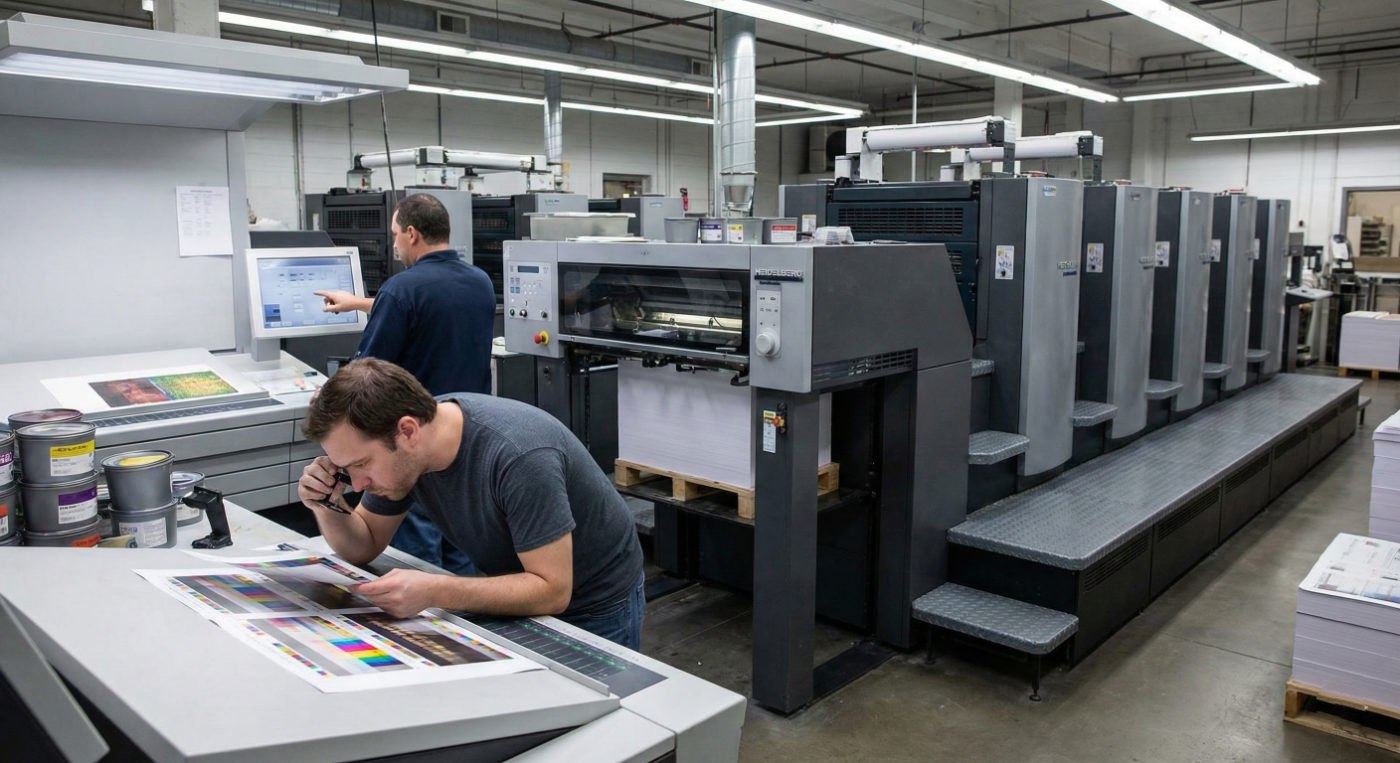
A hard proof serves as your insurance policy. Once you sign that physical proof, it becomes the “Golden Sample.” Our pressmen at ArtBook Printing keep that proof at the press console, constantly measuring the live ink flow against your approved sample to ensure copy #1,000 is identical to copy #1.
6. Peace of Mind for the Artist
Beyond the technical specs, there is a psychological weight to a hard proof. Holding a physical representation of your work allows you to “let go” of the anxiety of production. It confirms that the paper choice is right, the resolution is crisp, and the artistic intent has been preserved.
Conclusion: Don’t Skip the Final Check
In the pursuit of museum-quality results, the hard proof is the ultimate arbener of truth. It is the bridge between a digital dream and a physical legacy. At ArtBook Printing, we insist on this level of scrutiny because we know that once the ink flows onto the paper, there is no turning back.