

Introduction: More Than Just Glue and Thread
When people think about printing a book, they often focus on the paper and the ink. But the binding is what transforms a stack of loose prints into a cohesive, functional object. The binding dictates how the book feels in the hand, how it sits on a shelf, and—most importantly for artists—how the images are viewed when the book is open.
At ArtBook Printing, we see the binding as the architecture of your art. A poor choice can lead to a book that snaps shut on the reader or, worse, falls apart over time. In this guide, we explore the most popular binding methods for art books to help you choose the one that best supports your vision.
1. Smyth Sewn Binding (The Gold Standard)
If you are producing a premium art book or a monograph intended to last for generations, Smyth Sewn is the undisputed choice.
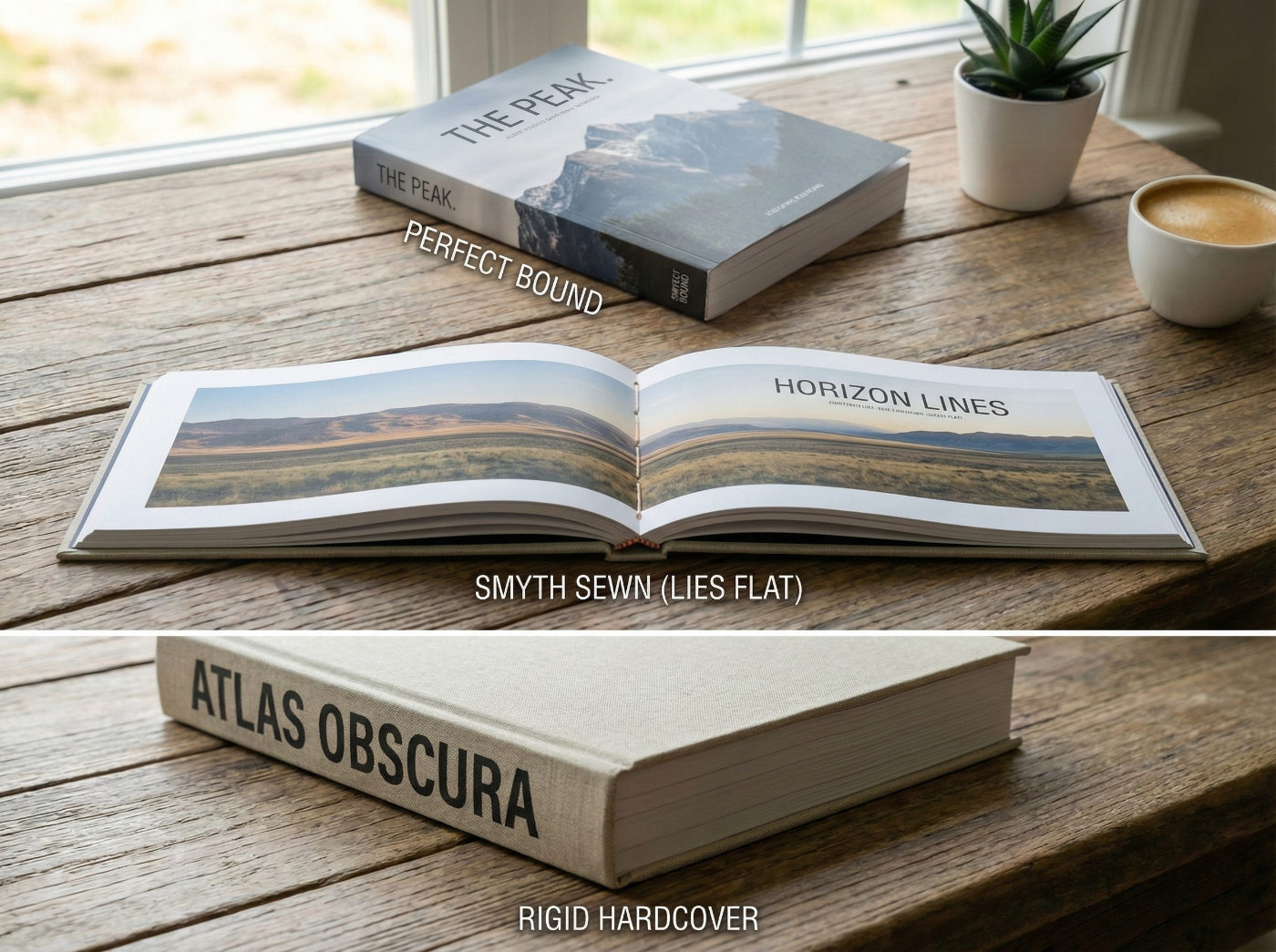
- The Process: Pages are folded into signatures (groups of 8, 16, or 32 pages) and literally sewn together with high-strength thread. These signatures are then glued into the spine.
- The Pros: It is incredibly durable. Because the pages are held by thread rather than just a strip of glue, the book can lay flat without the spine cracking. This is essential for art books featuring images that span across two pages.
- The Cons: It is more expensive and has a longer production time than standard glue-based methods.
- Recommendation: Use this for coffee table books, high-end portfolios, and anything with a page count over 100 pages.
2. Perfect Bound (Softcover)
This is the most common binding for paperbacks and high-quality catalogs.
- The Process: The block of pages is ground down at the spine to create a rough surface, and then a strong, flexible adhesive (usually PUR glue) is used to attach the cover.
- The Pros: Clean, modern look with a flat, printable spine. It is highly cost-effective for medium-to-large print runs.
- The Cons: It is stiff. The book will not stay open on its own, and you lose more of your image in the gutter (the center fold).
- Recommendation: Best for exhibition catalogs, zines, and lower-cost softcover art books.
3. Case Binding (Hardcover)
Case binding is the process of creating a rigid cover (the case) and attaching it to the book block.
- The Process: A heavy greyboard is wrapped in a material of your choice. The book block (usually Smyth sewn) is then attached to the case using endsheets.
- Options:
- Laminate Wrap: A printed, laminated paper wrapped around the board (standard for modern art books).
- Cloth/Linen Wrap: A luxury textile finish often paired with foil stamping.
- The Pros: Maximum protection and prestige feel. It commands a much higher retail price than softcover.
- The Cons: Heavy and expensive to ship.
- Recommendation: The only choice for Legacy projects and museum-grade publications.
4. Lay-Flat Binding
Photography-heavy books often suffer when the gutter eats into the composition. Lay-flat binding solves this.
- The Process: Rather than being glued directly to the spine, the pages are glued to each other or a specialized hinge, allowing the book to open 180 degrees without any curve in the center.
- The Pros: Seamless double-page spreads. Nothing is lost in the fold.
- The Cons: Significantly more expensive per unit and limited in terms of total page count.
- Recommendation: Ideal for thin photography books or portfolios where panoramic images are the focal point.
5. Hidden Gems: Swiss Binding and Singer Sewn
For the pro designer looking for something unique:
- Swiss Binding: The book block is only attached to the back cover. When you open the book, the spine floats away, allowing it to lay perfectly flat. It looks architectural and avant-garde.
- Singer Sewn: A single thread is visible on the outside of the spine. Great for thin, boutique art journals or limited edition chapbooks.
Comparison Summary: Which Binding Fits Your Project?
| Feature | Perfect Bound | Smyth Sewn | Case Bound |
| Durability | Moderate | High | Maximum |
| Lay-Flat Ability | Poor | Excellent | Good (if Sewn) |
| Retail Value | Low to Medium | Medium to High | Maximum |
| Price Point | Budget-Friendly | Premium | Luxury |
6. The Gutter Consideration
Regardless of your binding, you must design your files accordingly.
- For Perfect Binding: Increase your inner margin to 20mm to ensure text doesn’t fall into the fold.
- For Smyth Sewn: You can get away with 12mm–15mm margins, as the book opens much wider.
Conclusion: Your Choice Defines the Experience
Binding is the final touch that tells the reader how to interact with your art. Does it feel like a casual magazine to be flipped through, or a sacred object to be studied? At ArtBook Printing, we offer the full spectrum of binding technology. We recommend starting with the viewing experience you want for your audience, and then working backward to find the binding that makes it possible.